
10 October 2026 · Experimental design
Digging into winter bale grazing!
What actually happens to the soil when cattle spend the winter eating hay off a field?
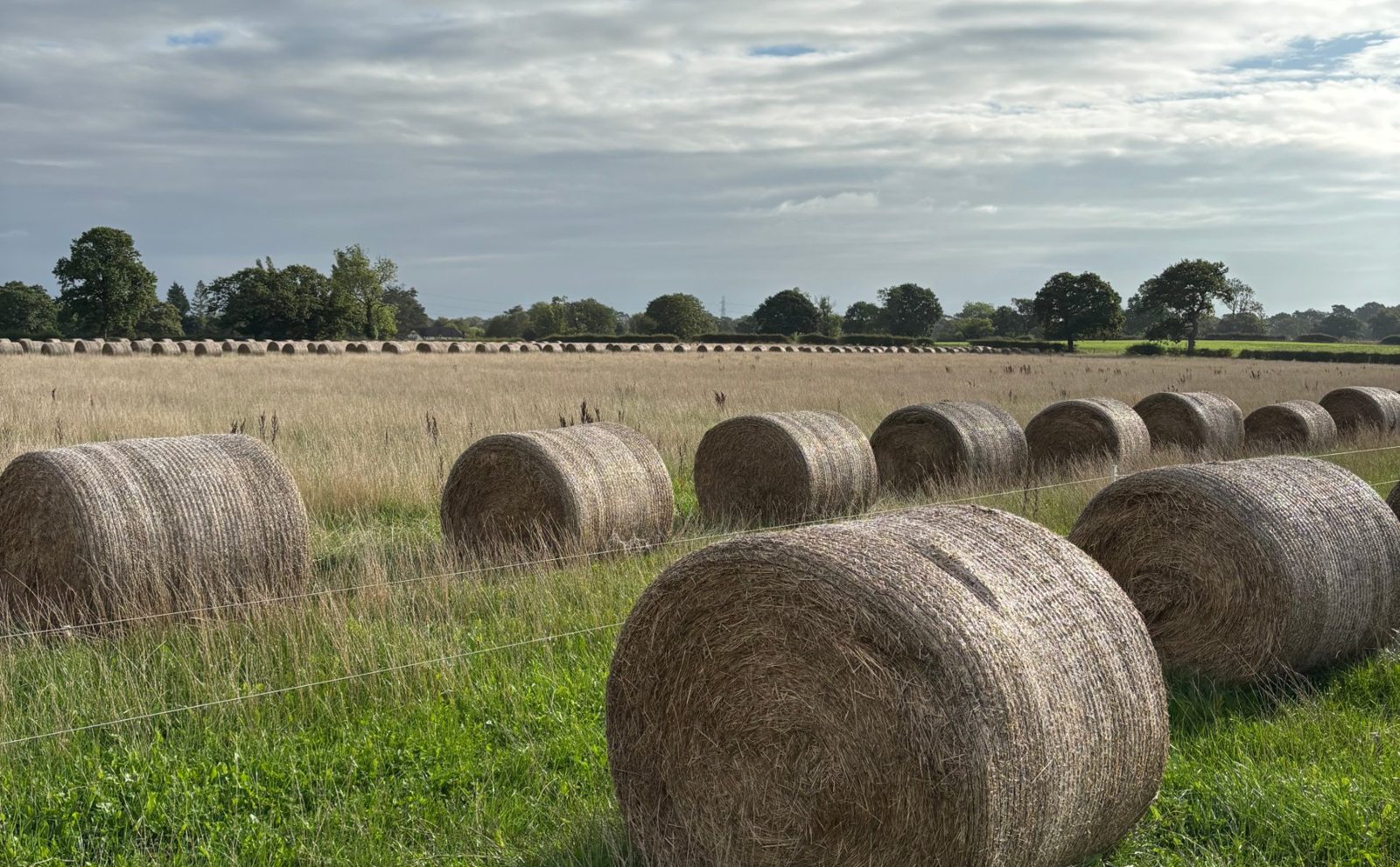
If you've driven past a field this autumn with rows of round bales sat out behind an electric fence, there's a good chance you were looking at bale grazing. The idea is simple: rather than housing cattle and carting feed to them all winter, you set the bales out in the field and move the fence along a strip at a time. Less tractor time, less muck to handle, less shed space. Lots of farmers we talk to swear by it.
What we can't tell them is what it's doing to the soil. And honestly, neither can anyone else, at least not for a wet British winter. So this winter, we're going to find out. We're working with farmers Jack Ancell and Ian Norbury at Mobberley Angus.
Is it feeding the soil or squashing it?
Here's the thing that makes bale grazing so interesting to us: it pulls the soil in two directions at once.
On one hand, you're dumping a huge amount of organic matter onto a small area. Wasted hay, dung and urine all pile up around each bale, and that should be a feast for soil microbes and for the fast breeding nematodes that graze on bacteria. More of them usually means more nitrogen being released for next year's grass.
On the other hand, you've got a lot of heavy animals standing in the same spot on wet ground for days at a time. That's a recipe for poaching and compaction, which squeezes the air out of the topsoil and can knock back the enzymes that drive nutrient cycling.
Which one wins? We genuinely don't know, and that's exactly why it's worth measuring.
What the research says so far
Not a lot that's directly useful, if we're honest. A big meta analysis of 38 studies found grazing cut soil enzyme activity by about 12% on average, and by 20% under heavy grazing (Feng et al., 2025). But it also found cattle actually boosted several enzymes, unlike sheep, and that the biggest drops happened in the first few years of a new grazing system. A Canadian study of adaptive multipaddock grazing found enzyme gains, but only in September, and found that soil moisture and texture mattered far more than how the land was grazed (Kaliaskar et al., 2026).
The catch is that almost all of this work comes from dry rangeland, mountains or forests. Very little of it looks anything like a soggy lowland pasture in a British winter.
Two fields will always be different, so comparing a bale grazed field with the one next door doesn't tell you much. What matters is whether the bale grazed ground changes more over the winter than ground that wasn't bale grazed.
So what are we actually doing?
We're sampling the same spots before the cattle go onto each strip in November, again within a week of them coming off, and once more in spring before turnout. Ecologists call this a before, after, control and impact design, which is a fancy way of saying every patch of ground gets compared with itself, and then with ground that didn't get the treatment.
We've got 32 fixed points, all marked by GPS. Eight sit right by the bales, eight sit in the gaps between them, eight are in a strip of the same field that we're fencing off with no bales or cattle at all, and eight are spread across a conventionally managed field nearby. That unfed strip is the really important one, because it has the same soil and history as the bale grazed ground, so any difference has to come from the bale grazing itself.
What we're measuring
At every point we're looking at three things from the same bag of soil:
Soil enzymes. We're using a Digit Soil reader, a clever portable gadget from a Swiss spin out that measures five enzymes involved in carbon, nitrogen and phosphorus cycling, on fresh soil, in about 40 minutes. One quirk is that its readings jump around with temperature, so we're running everything at a steady 20 °C to keep November and spring comparable.
Nematodes. Our old favourites. We'll be extracting them and sorting them under the microscope into who eats what, because the balance between bacteria feeders, fungus feeders and predators tells you a lot about how the soil food web is working (Ferris et al., 2001).
Soil chemistry and structure. Mineral nitrogen, pH, phosphorus, potassium, organic matter, bulk density and compaction, plus notes on cattle numbers, days per strip, hay left behind, dung and poaching.
What would the results tell us?
If the enzymes, the bacteria feeding nematodes and the nitrogen all go up next to the bales without the soil getting more compacted, that's a fertility boost, and good news for bale grazing. If the enzymes drop and the soil gets tighter, the treading is doing more harm than the hay is doing good. Our hunch is we'll see a bit of both: gains right by the bales and damage in between, which is exactly the kind of thing a single field average would completely hide.
And if the nematodes and chemistry move but the enzymes don't? That's still useful, because it tells us whether a quick on farm enzyme test is sensitive enough to be worth a farmer's time.
Where this goes next
This is a pilot for the bigger PhD work, which looks at how the soil food web controls carbon and nitrogen across farms with different grazing systems. It's only one farm, so we'll be careful not to oversell whatever comes out of it, but it's a brilliant test of how quickly soil life responds to a big, sudden grazing event. We'll share what we find here next summer. If you bale graze yourself and want to compare notes, we'd love to hear from you.
References
Feng, J. et al. (2025) Effect of grazing on soil enzyme activities in grassland ecosystems: a meta analysis. Grassland Science 71(3). Kaliaskar, D. et al. (2026) Extracellular enzyme activities under adaptive multipaddock and conventional grazing in grassland soils of western Canada. Pedobiologia 114, 151118. Ferris, H., Bongers, T. and de Goede, R.G.M. (2001) A framework for soil food web diagnostics. Applied Soil Ecology 18.