
18 September 2026 · PhD research
What's happening under your feet
Why I'm studying nematodes to understand grazing and carbon.
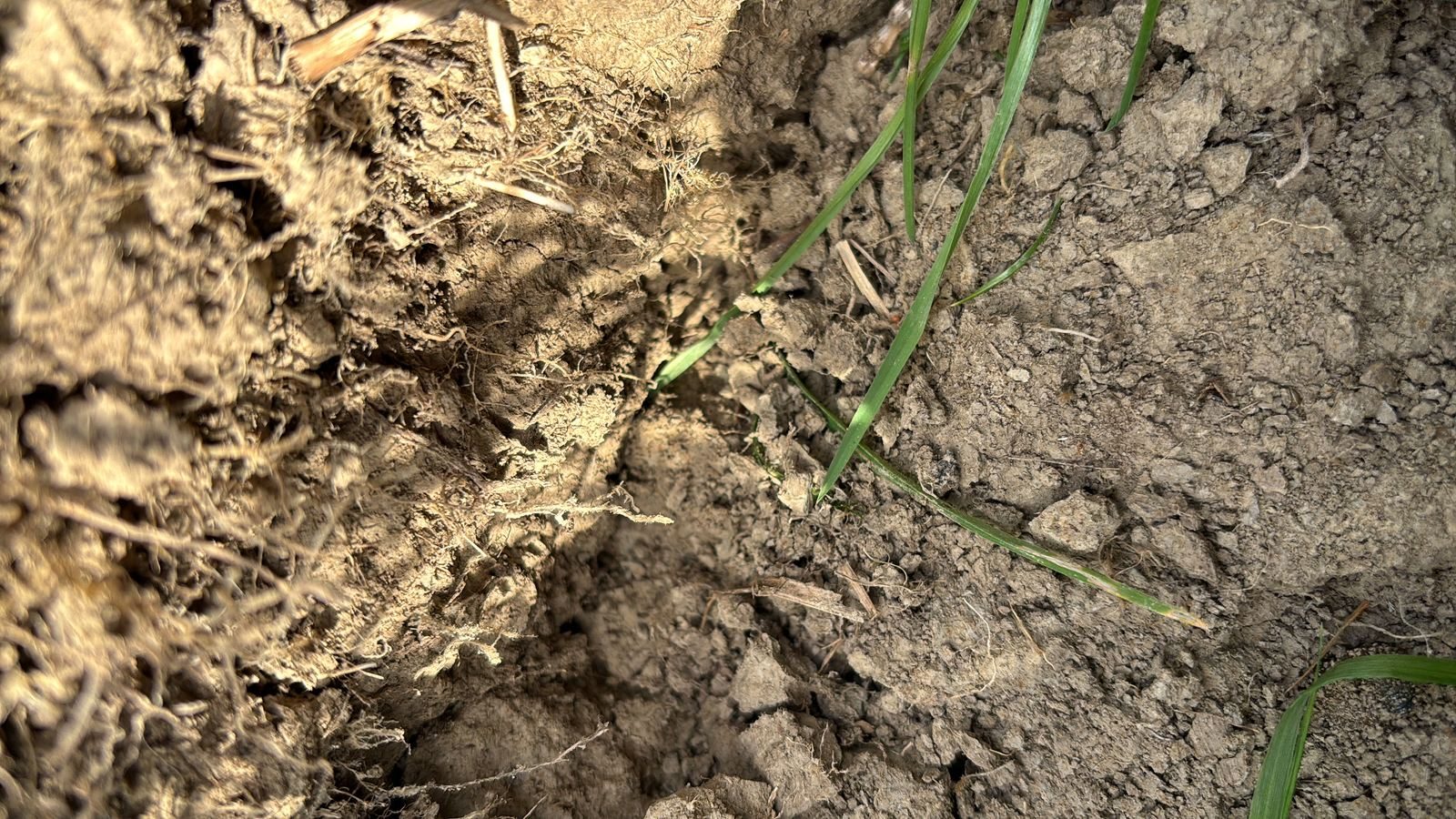
If you'd asked me a few years ago what a nematode was, I'd have given you a vague answer about "a worm, probably." Now I spend a good part of my working life thinking about them, because I've come to believe they might be one of the most useful, most overlooked indicators we have of whether a grazing system is actually working with the soil beneath it, or against it.
This is the question sitting at the centre of my PhD at IBERS, Aberystwyth University: how does nematode trophic structure regulate soil carbon and nitrogen cycling in grazing systems?
It's a mouthful. Here's what it actually means, and why I think it matters for anyone managing grazing land.
The problem with "grazing is good" or "grazing is bad"
Grasslands hold an enormous amount of carbon, and most of it isn't in the grass you can see. It's underground. Grazing management has a huge influence over whether that carbon stays there or gets released, but the research on this is frustratingly inconsistent. Moderate grazing often seems to boost root growth and carbon inputs into soil. Heavy grazing often seems to strip it away through compaction, biomass removal, and disrupted microbial activity. But "often" is doing a lot of work in that sentence, because the direction and size of the effect depends heavily on context, and we don't have a great mechanistic explanation for why.
I think part of the reason is that most of this research skips past a middle layer entirely: what's actually living in the soil, and how it responds.
Why nematodes specifically
Nematodes sit in an unusually useful spot in the soil food web. They feed at every level, on bacteria, on fungi, on plant roots, on each other, which means their community structure reflects a huge amount of what's happening around them. A soil dominated by bacterial-feeding nematodes tells a different story to one dominated by fungal-feeders or by omnivores and predators, and those different stories map onto different rates of carbon turnover and nitrogen release.
There's also a well-established toolkit for reading that story. Using indices developed by Ferris and colleagues, the Enrichment Index, Structure Index, Channel Index and metabolic footprints, you can turn a nematode sample into a genuinely informative snapshot of soil food web condition, without having to guess.
Three linked questions sit at the core of the project: do soil physical and chemical properties shape nematode trophic structure; does grazing intensity alter plant productivity, carbon inputs and nematode trophic structure; and does nematode trophic structure itself regulate carbon turnover and nitrogen mineralisation.
How I'm testing it
Between now and 2030 I'll be working across 4 to 6 farms spanning a climate gradient, with grazing-exclusion plots set against actively grazed ground in the same fields, sampled seasonally over three years. Alongside the nematode work, I'm collecting soil physical and chemical data, carbon fractions, microbial biomass, and vegetation productivity, so the nematode picture sits inside a fuller picture of what's driving it.
Where this sits in the wider research
I'm not working in a vacuum here, and it's worth being honest about that. A growing body of recent work is converging on similar territory, sometimes confirming what I'd expect, sometimes complicating it.
A meta-analysis of nearly 2,000 paired observations worldwide found that grazing generally reduces bacterial-feeding and omnivore-predator nematode abundance, and lowers community diversity overall, though the effect varies a lot by grazing intensity, animal type and duration. That variability is exactly the kind of thing my farm-gradient design is trying to pin down more precisely.
Other studies complicate the "grazing is simply bad for nematodes" story. Work in a meadow steppe found that light grazing actually increased total nematode abundance, while only intensive grazing reduced the metabolic activity of the community, tracking closely with soil CO2 flux. That's a useful reminder that intensity, not grazing itself, is probably the variable that matters.
There's also good recent evidence for the mechanism I'm most interested in: nematode trophic groups measurably influencing carbon and nitrogen outcomes, not just responding to them. One study in permafrost grassland found nematode trophic composition accounted for a meaningful share of variation in soil organic carbon and total nitrogen, even after accounting for the much larger role of plant inputs. Similarly, research on grazing exclusion has shown it shifts soil microbial communities in ways that measurably increase the conversion of particulate organic carbon into more stable, mineral-associated carbon, which is a plausible mechanistic bridge between what's happening in the food web and long-term carbon storage.
Not everything points the same direction, which is exactly why this needs testing properly rather than assumed. A study in an alpine Tibetan meadow found that excluding grazing actually decreased certain nematode groups and reduced phosphorus mineralisation, the opposite of what a simple "grazing exclusion is always good for soil biology" story would predict. And a very recent paper on alpine grassland restoration found nematode effects on plant-soil feedback flipped direction entirely depending on the successional stage of the soil, reducing plant biomass in early-stage soils but enhancing it in later-stage ones. Context clearly matters enormously, which is part of why my study design spans a climate gradient rather than a single site.
Why this matters beyond the PhD
If the mechanism holds up, it has a genuinely practical payoff. Right now, most on-farm indicators of soil health are chemical: pH, phosphorus, organic matter percentage. Nematode community structure could become another repeatable, biologically meaningful indicator that says something about how a soil is actually functioning, not just what it contains. That's the kind of tool I want to be able to hand back to the farms I work with through Soil Steps, not just publish in a journal.
Related papers referenced in this post
- Ferris, H., Bongers, T. and de Goede, R.G.M. (2001) 'A framework for soil food web diagnostics: extension of the nematode faunal analysis concept', Applied Soil Ecology, 18, pp. 13 to 29.
- 'Effects of grazing intensity on soil nematode community structure and function in different soil layers in a meadow steppe', Plant and Soil (2021).
- 'Grazing alters the soil nematode communities in grasslands: A meta-analysis' (2024).
- 'Grassland degradation indirectly impacts soil carbon and nitrogen by altering nematode communities in permafrost area' (2025).
- 'Grazing exclusion enhanced the capability of soil microorganisms to access photosynthetic carbon in Loess Plateau grassland' (2025).
- 'Livestock grazing-exclusion under global warming scenario decreases phosphorus mineralization by changing soil food web structure in a Tibetan alpine meadow' (2023).
- 'Herbivore species and patch heterogeneity modulate grazing-induced shifts in soil nematode trophic structure and energy flux', Functional Ecology (2026).
- 'Nematode trophic networks drive stoichiometry-dependent plant-soil feedback across alpine grassland restoration chronosequences' (2025).
- 'Soil Food Webs and Carbon Dynamics in Response to Conservation Tillage in California' (2007).
Full author lists and journal volume details for the recent papers above are being confirmed directly with the journals ahead of any formal citation.