
19 August 2026 · Soil biology
The microscopic decision-makers: what nematodes tell us about carbon
Whether a field genuinely delivers the ecosystem services that regenerative agriculture promises it will, carbon storage, nutrient cycling, a more resilient soil, may depend less on the cattle grazing it than on animals invisible to the naked eye: nematodes, roundworms typically under a millimetre long, extracted from soil samples and counted under a microscope.
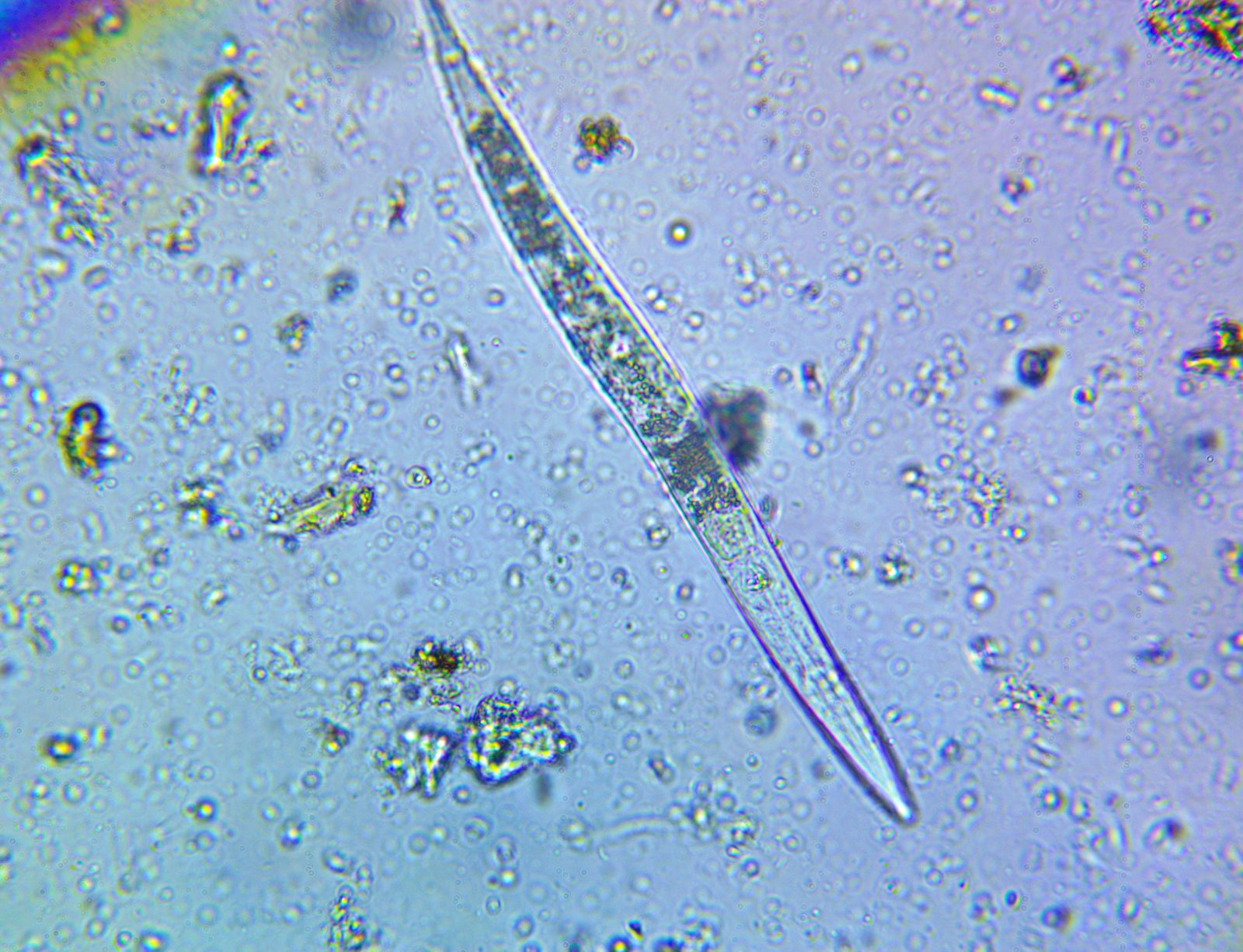
Nematodes occupy a genuinely useful position within the soil food web, sitting across multiple trophic levels and linking microbial communities to the organisms above them, with different species responding differently, and predictably, to disturbance. That makes them among the most established bioindicators of soil ecosystem condition in the literature (Bongers, 1990; Ferris et al., 2001), even though almost nobody outside soil ecology is aware they are used this way.
Why the mix of species matters more than the count
The useful information is not how many nematodes are present in a sample, but the balance between functional groups, bacterivores, fungivores, herbivores, omnivores, and predators, and what that balance implies about how carbon is moving through the system. The working hypothesis, based on established nematode functional analysis frameworks, is that soils dominated by fungal-feeding and higher trophic-level nematodes, omnivores and predators, are associated with slower carbon turnover, greater carbon retention, and more tightly regulated nitrogen release, whereas soils where bacterial-feeding nematodes dominate tend to show faster carbon turnover and quicker, less regulated nitrogen mineralisation (Ferris et al., 2001; Ferris, 2010).
Put plainly, two fields can add carbon to the soil at the same rate and still tell completely different stories a year later, depending on who is eating whom underground: a field pushing nutrients through a fast bacterial channel is cycling carbon quickly, some of it straight back to the atmosphere, while a field with a more structured, fungal and predator rich food web is holding onto more of it. Indices such as the Enrichment Index, the Structure Index, the Channel Index, and metabolic footprints exist specifically to quantify that difference (Ferris et al., 2001; Ferris, 2010).
The evidence this is not a niche argument
This is not merely a hunch specific to this project. De Vries et al. (2015), in a study spanning European land use systems, found that soil food web properties explain ecosystem service delivery directly, rather than as a minor add-on to bulk carbon or nutrient measurements, a finding that presents a fairly direct challenge to how most current carbon and ecosystem service accounting works, treating the food web as background noise rather than as the mechanism actually regulating the outcome being measured.
My own fieldwork tries to close that gap directly for grazing systems specifically, extracting nematodes from soil cores across a real gradient of grazing intensities, classifying them by trophic group, and testing statistically, via structural equation modelling, whether grazing-driven changes in plant inputs and soil structure actually show up as changes in food web structure, and whether that food web structure predicts the carbon and nitrogen cycling outcomes that matter (De Vries et al., 2015; Bardgett & Wardle, 2010).
Why this should change how claims get made
None of this is a call to make carbon accounting more complicated for its own sake, but a call to measure the mechanism actually doing the work. A soil sample returning a healthy bulk carbon number but a degraded, bacterially dominated food web is not the same asset as one with the same number and a structured, predator rich food web, even though most current reporting would treat them identically. Until ecosystem service claims from regenerative agriculture begin accounting for what is happening within the soil food web, they are describing an outcome without being able to say whether it will hold.